Expressing enjoyment: Simple or continuous?

We know that when an English-speaker says “I love biking to work,” he means that he enjoys this activity.  He probably does it as a habit (every day, for example).

But what does he mean if he says “I’m loving biking to work”?

Here he means that he is enjoying an activity that he has just started doing recently.  Perhaps he used to drive to work every day, but this month he has started biking.  He uses the present continuous (“am loving”) to emphasize that this is new and ongoing.

We can use this same form with other ’emotion’ verbs like hate, like, enjoy, appreciate, etc. 

On your own…

Choose the correct form to complete the sentence.

1. “Brian (is hating/hates) his new job.”

“Really? That’s too bad – he only started a week ago!”

2.  My wife always (appreciates/is appreciating) when I help with the dishes.

3. I think Debra (is enjoying/enjoys) her free time, now that her youngest son has moved away to college.

4. “(Do/Are) you (like/liking) Mexican food?”

5. Alex (is finding/finds) his new roommate very hard to live with.  He may need to find a new apartment already!LES leaf


Answer key

1. is hating  2. appreciates  3. is enjoying  4. Do/like  5. is finding
Words (and phrases) to know: ‘in the dark’

This idiom means to be kept without information.

  •  Adam has know all along just how serious their money situation is, but he’s kept Lauren in the dark because he didn’t want her to worry.
  • Voters complain that the government wants to keep them in the dark about that is really going on.

Notice that the pronoun is always inside the phrase: “to keep them in the dark” (not “to keep in the dark them“). LES leaf

Are you superstitious?

A superstitious person believes in stories or traditions that have no explanation.  Here are a few common superstitions you’ll hear in English:

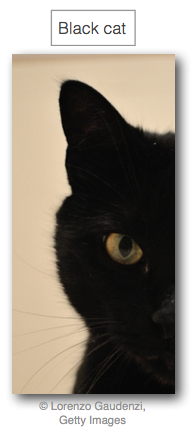
  • knock on wood (by knocking on wood, you prevent something bad from happening when you’ve just mentioned "Black cat"something good)

“So far I’ve done really well on each of my biology exams…knock on wood.”

  • jinx (Very similar to ‘knock on wood’)

“What a nice day for our hike…and not a cloud in the sky!”

“Don’t jinx us! Now it’ll rain for sure!”

  • beginner’s luck (A person does well on their first try)

“Adam’s won almost $200 in his card game, and he’s never even played before. Amazing!”

“Oh, I bet it’s just beginner’s luck.  Just wait.”

  • bad luck comes in threes 

“First my alarm didn’t go off this morning, then I spilled coffee on myself and now I’ve missed the bus home.  Like they say, bad luck comes in threes…”

  • 13 (The number is thought to be unlucky)

“Did you know that many American elevators go from the 12th floor to the 14th, and skip over the 13th? It’s thought that the 13th floor would be too unlucky!”

In your own words…

Tell us about some of the superstitions in your country.  Are they very similar to these?